Newest Products
Why you shouldn’t use a standard SMPS to charge a battery (And what happens if you do?)”
It might seem cost-effective to repurpose a standard Switch Mode Power Supply (SMPS) for battery charging, but this approach fundamentally fails because standard power supplies lack the critical current regulation and termination logic required for safe chemical energy storage. A standard SMPS is designed to deliver a constant voltage regardless of load, whereas a battery requires a specific charging profile—typically Constant Current (CC) followed by Constant Voltage (CV)—to prevent damage to both the source and the battery.
The Core Conflict: Constant Voltage vs. Constant Current
The primary reason a standard SMPS fails as a charger is its control loop topology. A standard industrial SMPS is a Constant Voltage (CV) source; its sole objective is to keep the output voltage fixed (e.g., at 24V DC) as the load varies.
In contrast, a depleted battery acts as a massive capacitor with very low internal resistance. When you connect a standard CV supply to a discharged battery, the voltage difference causes the battery to draw as much current as possible—often exceeding the SMPS’s maximum rating. A dedicated battery charger actively manages this phase using Constant Current (CC) mode, limiting the flow to a safe level until the battery voltage rises. Because a standard SMPS lacks this limiting feature, it attempts to source infinite current to force the voltage up immediately, leading to component stress or failure.
The “Hiccup Mode” Phenomenon
When a standard SMPS detects the massive current draw from a dead battery, its internal protection circuits interpret this as a short circuit or overload fault.
- Overload Protection Trigger: Most modern SMPS units have “hiccup mode” or foldback current limiting.
- The Loop of Failure: The supply detects over-current shuts down to protect itself restarts after a brief delay detects the “short” (the battery) again shuts down again.
- Result: The battery never charges, and the power supply components undergo thermal stress from rapid cycling.
Voltage Mismatch and Termination Risks
Even if the current doesn’t trip the protection (e.g., if the battery is partially full), the voltage levels and termination logic are incompatible.
- Incorrect Voltage Potential: A “12V” SMPS typically outputs exactly 12.0V. However, a 12V Lead-Acid battery requires ~13.8V to ~14.4V to reach a full charge state. Connecting it to a 12.0V source will leave the battery perpetually undercharged, leading to sulfation and capacity loss.
- No Termination Logic: A dedicated charger monitors the battery’s state and cuts off power (or switches to a trickle float charge) when full. A standard SMPS will continue pumping energy into the battery indefinitely if the voltage allows, or conversely, it will simply stop pushing current once the battery reaches the SMPS’s set voltage, leaving it undercharged.
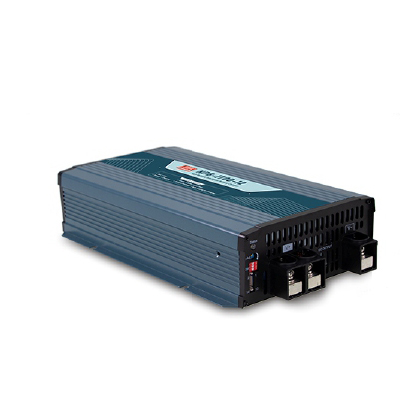
Comparison: Standard SMPS vs. Dedicated Charger
| Feature | Standard Industrial SMPS | Dedicated Battery Charger |
| Control Mode | Constant Voltage (CV) Only | Constant Current (CC) + Constant Voltage (CV) |
| Overload Response | Shuts down / Hiccups (Protects itself) | Limits current (Protects battery) |
| End-of-Charge | None (risk of over/undercharge) | Automatic Cut-off / Float Mode |
| Safety | Short-circuit protection only | Reverse polarity, thermal runaway protection |
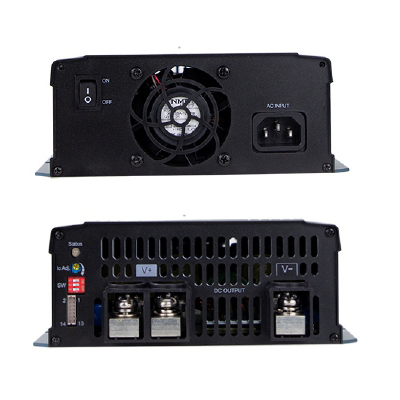
Strategic Recommendation
For industrial applications, relying on standard power supplies for charging creates a liability. The lack of proper charging algorithms can destroy expensive battery banks and cause system downtime due to “hiccup” faults.
- Engineer’s Fix: If you absolutely must use an SMPS bus for charging, you cannot connect it directly. You must interface it with a DC-DC Charger or a dedicated charging IC that takes the constant DC bus voltage and converts it into the correct CC/CV profile for the battery chemistry.
- Decision Maker’s Takeaway: Investing in purpose-built charging hardware ensures warranty compliance for your batteries and prevents the hidden costs of premature battery failure and power supply replacement.